
From photonic integrated circuits to intelligent network automation, explore the foundational technologies that power Infinera's optical transport solutions.
Infinera's vertically integrated photonic IC platform consolidates hundreds of optical functions onto a single indium phosphide chip. Each PIC integrates tunable lasers, Mach-Zehnder modulators, PIN photodetectors, and variable optical attenuators, delivering up to 2.4 Tbps of aggregate capacity in a single line card.
| Parameter | Specification |
|---|---|
| Integration Density | 500+ optical functions per PIC |
| Line-Side Capacity | Up to 2.4 Tbps per slot |
| Power Efficiency | < 0.5W per 100 Gbps |
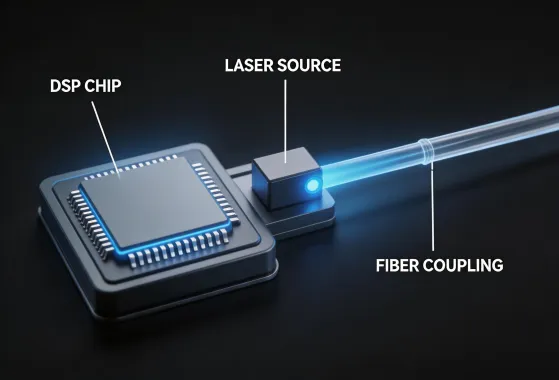
Our coherent DSP engine supports probabilistic constellation shaping and adaptive modulation from QPSK to 64QAM, dynamically optimizing spectral efficiency based on fiber characteristics. Advanced forward error correction achieves near-Shannon-limit performance with net coding gain exceeding 12 dB.
| Parameter | Specification |
|---|---|
| Max Baud Rate | 100 GBd |
| Modulation Formats | QPSK to 64QAM (PCS) |
| FEC Net Coding Gain | > 12 dB (oFEC) |
Infinera actively participates in standards bodies to ensure interoperability and drive industry innovation.
Contributing to G.698.x and G.709 standards for optical transport network interfaces and OTN framing.
Active contributor to vendor-neutral YANG models for terminal devices, optical amplifiers, and wavelength router configuration.
Co-authoring 400ZR+ and 800ZR implementation agreements for coherent pluggable interoperability.
Compliance with IEC 61300 series for fiber optic interconnecting devices and IEC 61280 for transceiver measurement methods.
Member of the Open Optical & Packet Transport group, advancing disaggregated optical networking for global carriers.
All carrier-grade platforms certified to NEBS Level 3 (GR-63-CORE, GR-1089-CORE) for central office deployment.
Informed equipment selection requires understanding the engineering compromises inherent in different architectural approaches.
Carriers face a fundamental trade-off when architecting optical transport networks. A single-vendor integrated stack (e.g., one supplier for transponders, amplifiers, and NMS) provides unified management, a single escalation path for troubleshooting, and pre-validated interoperability, which reduces deployment risk and accelerates turn-up.
However, open/disaggregated approaches using OpenConfig YANG models and white-box transponders enable best-of-breed component selection, avoid long-term vendor lock-in, and can reduce hardware costs by 20-40% according to TIP (Telecom Infra Project) field trials published in 2023. The trade-off is increased integration complexity and the need for in-house optical engineering expertise.
Infinera supports both models: our proprietary platforms offer turnkey integration, while our open line system participates in multi-vendor disaggregated architectures. The right choice depends on the operator's engineering resources and procurement strategy.
AON architectures place powered equipment at each distribution point, providing dedicated bandwidth per subscriber and easier per-user monitoring. AON supports longer reach (up to 80 km) and is preferred for enterprise-grade deployments where SLA guarantees require per-link visibility.
PON architectures (GPON, XGS-PON, 50G-PON) use unpowered optical splitters, eliminating field-powered equipment and reducing OPEX by an estimated 30-50% in high-density residential deployments. However, PON shares bandwidth across subscribers (typically 1:32 or 1:64 split ratios), which introduces contention under peak load.
For DWDM transport backhaul feeding PON or AON access networks, capacity planning must account for the aggregation model chosen at the access layer.
Every optical transport technology operates within physical and engineering constraints. Understanding these boundaries is essential for accurate network planning.
At launch powers above +3 dBm per channel on standard single-mode fiber (ITU-T G.652), Kerr-effect nonlinearities (self-phase modulation, cross-phase modulation, four-wave mixing) degrade signal quality. Higher-order modulation formats like 64QAM are more susceptible to nonlinear impairments, limiting their practical reach to approximately 500 km without regeneration.
Carrier-grade optical equipment is rated for -5 to +55 degrees Celsius ambient temperature per NEBS Level 3 (GR-63-CORE). Outdoor deployments in extreme climates (desert, arctic) require supplemental thermal management. Humidity above 85% non-condensing can affect connector performance over time, necessitating sealed enclosures rated IP65 or higher.
400ZR pluggable modules in QSFP-DD form factor are constrained to approximately 15W thermal dissipation, which limits DSP complexity and reach to 120 km at 400G. For longer distances (400ZR+ at 800+ km), higher-power CFP2-DCO modules or line-card-based solutions are required, at the cost of higher power consumption (typically 60-80W) and larger footprint.
Download white papers, system specifications, and application notes from our optical technology library.
Request Documentation